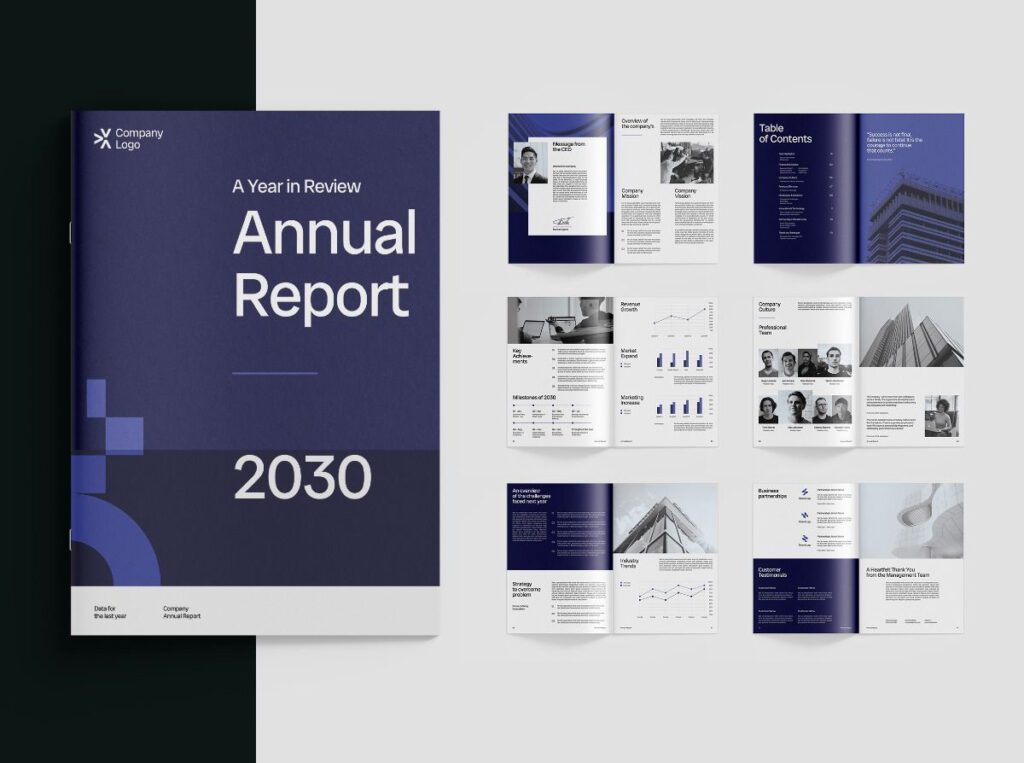
An annual report is not a marketing document.
It is a formal business communication that represents a company’s performance, governance, and direction over a defined financial year.
For most organisations, the annual report is reviewed by boards, shareholders, regulators, investors, and auditors. Its effectiveness depends on how clearly information is structured, presented, and supported, not on visual appeal alone.
This article explains what makes an annual report effective, with a focus on structure, content, and annual report design.
What Is an Annual Report and Why It Matters
An annual report is a statutory and stakeholder-facing document that consolidates financial results, management commentary, governance disclosures, and strategic outlook.
It serves several important purposes:
- Communicating performance to shareholders and investors
- Demonstrating governance and accountability
- Providing transparency to regulators and stakeholders
- Ensuring consistency in corporate reporting
Because of its formal role, errors in structure, clarity, or presentation can affect credibility and create unnecessary risk.
The Importance of Structure in an Annual Report
Structure is the foundation of an effective annual report. It determines how information is accessed, interpreted, and reviewed.
A well-structured annual report generally follows a logical flow:
- Corporate overview and leadership messages
- Business performance and operational highlights
- Financial statements and notes
- Governance, risk, and compliance disclosures
- Strategic priorities and future outlook
Clear sectioning, consistent hierarchy, and predictable navigation help readers locate information efficiently and reduce ambiguity during review.
Poor structure often results in repetition, confusion, and misinterpretation.
Content That Supports Reporting Requirements
Annual report content must balance completeness with clarity.
Key principles include:
- Accuracy and consistency across all sections
- Alignment between narrative commentary and financial data
- Clear explanation of performance drivers and results
- Transparent disclosure of governance and risk
Content should inform rather than persuade. Promotional language weakens credibility and may raise concerns during audits, regulatory review, or stakeholder scrutiny.
Effective annual reports maintain a factual, professional tone throughout.
The Role of Annual Report Design
Annual report design plays a functional role rather than a decorative one.
Good annual report design supports:
- Readability of complex financial and operational information
- Clear differentiation between sections and disclosures
- Consistent presentation of data, tables, and commentary
- Alignment with established corporate brand standards
Design choices should improve comprehension and usability. Excessive visual treatment or inconsistent layouts can reduce clarity and complicate review processes.
Data Presentation and Visualisation
Financial and operational data form the core of any annual report.
Effective data presentation involves:
- Clear charts and tables with proper labelling
- Consistent scales, formats, and units
- Visual summaries that support detailed disclosures
Data visualisation should simplify understanding without distorting meaning. Misleading or unclear visuals can undermine trust and accuracy.
Print and Digital Considerations
Annual reports are commonly distributed in multiple formats.
An effective annual report is designed for:
- Print production and physical circulation
- PDF viewing and digital distribution
- Screen readability across devices
Considering these formats early in the annual report design process helps avoid last-minute adjustments and inconsistencies.
Common Issues That Reduce Annual Report Effectiveness
Organisations often encounter avoidable challenges, including:
- Dense layouts with poor hierarchy
- Inconsistent terminology or data references
- Weak navigation across sections
- Visual emphasis that overshadows content
- Late-stage changes affecting accuracy
These issues are usually the result of limited planning rather than lack of effort.
Planning for an Effective Annual Report
Effective annual reports require structured planning.
Best practices include:
- Early scope definition and timelines
- Clear roles across finance, secretarial, communication, and design teams
- Defined review and approval cycles
- Alignment between content development and annual report design
A disciplined approach reduces risk and improves overall quality.
Final Thoughts
An effective annual report is built on clarity, accuracy, and structure.
It communicates performance without exaggeration, presents data without distortion, and reflects governance without ambiguity. Annual report design supports this objective by improving readability and consistency rather than adding visual complexity.
Organisations that treat annual reporting as a structured business process rather than a production task are better positioned to meet statutory expectations and stakeholder scrutiny.